Research

Our Research

8up.ai is built on rigorous science. We develop state-of-the-art AI methods for dietary assessment and partner with academic researchers to validate them in real clinical studies.

Technical Report · August 2026

Nutrition Data Infrastructure for the AI Era: Operationalizing FAIR for Agent-Mediated Research

8up.ai Research

AI agents can accelerate nutrition research, but their analyses inherit the identity, semantic, and release ambiguities of the underlying data. We present Nutrition Data Service (NDS), source-preserving infrastructure that operationalizes FAIR for automated use: description resolution makes release-specific records findable, typed crosswalks connect independently released resources, and machine-readable interfaces expose versioned sources and crosswalks so agent analyses stay replayable and auditable. NDS shows strong held-out accuracy on food-description benchmarks and outperforms the best published language-model result on NutriBench. In a person-level glycemic-index analysis, pinned NDS inputs produce identical outputs across models and repeated runs, while open-web reconstruction remains unstable.
Technical Report · July 2026

Geometry-Enhanced Portion Estimation for Multimodal LLMs

8up.ai Research

Multimodal LLMs recognize a wide range of foods zero-shot in real-world photos, yet they are weak at portion estimation. We present a small geometry-enhanced network on a frozen DINOv2 backbone with a structured softmax-ownership volume that reasons jointly over all detected foods — no depth sensor and no MLLM fine-tuning. Across three real-world benchmarks, it cuts per-food portion error by 33–41% relative to the MLLM alone, outperforms every flagship MLLM's direct estimates, and surpasses each benchmark's originally published image-only model at its own reported metric.

Clinical Study · University of Washington

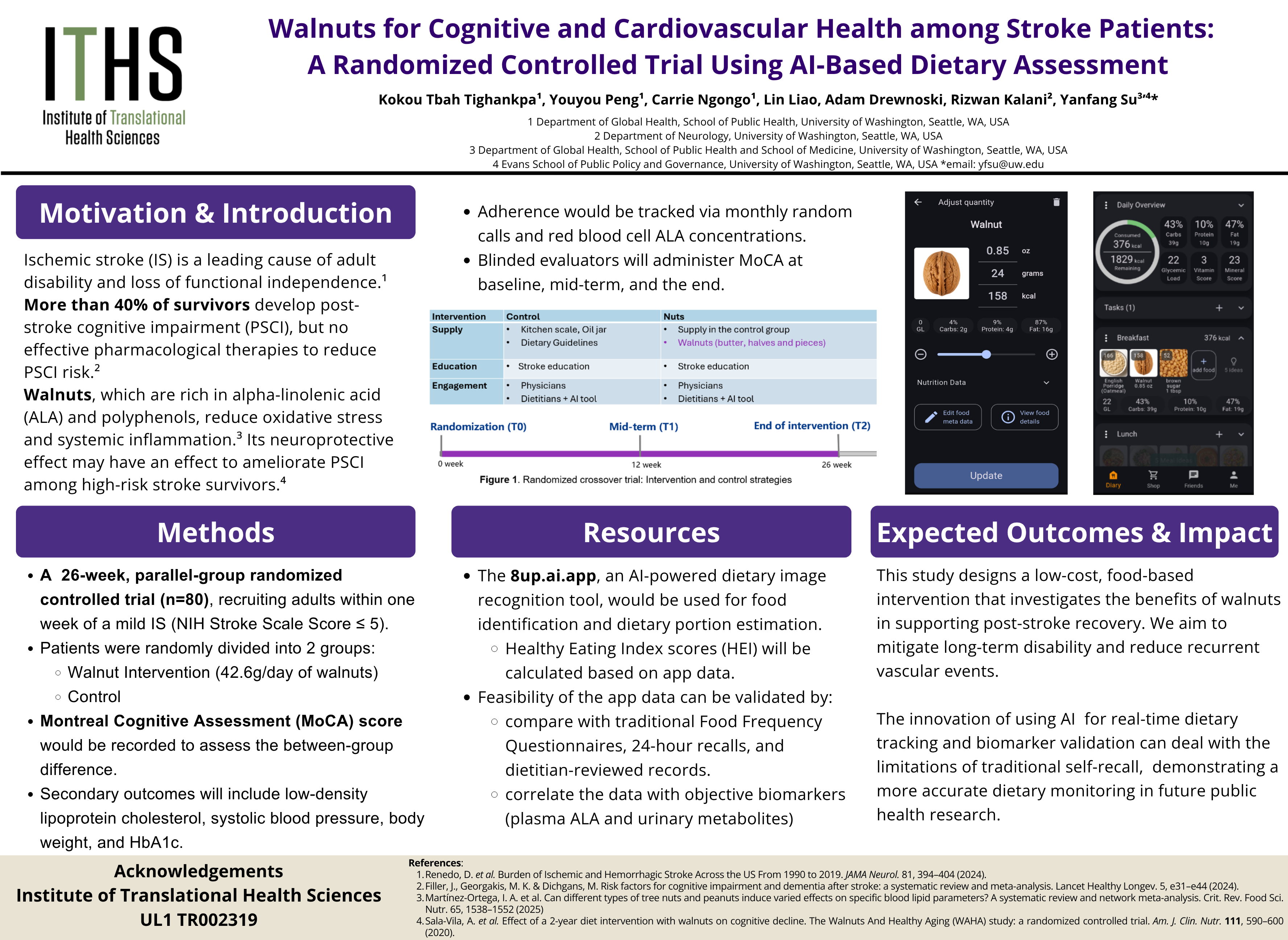
Walnuts for Cognitive and Cardiovascular Health among Stroke Patients

A randomized controlled trial using AI-based dietary assessment, with the University of Washington School of Public Health.

More than 40% of ischemic stroke survivors develop post-stroke cognitive impairment, with no effective pharmacological therapies to reduce the risk. This 26-week randomized controlled trial (n=80) investigates whether a daily walnut intervention can support post-stroke recovery. The 8up.ai app powers real-time food identification and portion estimation, with app data validated against traditional dietary questionnaires and objective biomarkers — demonstrating more accurate dietary monitoring for public health research.

Research poster: Walnuts for Cognitive and Cardiovascular Health among Stroke Patients